Top 10 Types of Filing Cabinets for Global Buyers

Time:2026-10-09 Author:Isabella
0%

Choosing the right Filing Cabinets can influence office security, workflow, storage capacity, and long-term purchasing costs. Global buyers often compare more than appearance. They assess steel thickness, drawer capacity, locking systems, fire resistance, corrosion protection, and delivery requirements. A cabinet that performs well in a dry office may struggle in a humid warehouse or coastal location.

This guide introduces ten practical types, including vertical, lateral, mobile, fire-resistant, modular, and electronic filing cabinets. Each option serves a different working environment. Vertical cabinets save floor space, while lateral models offer wider drawers and easier file visibility. Mobile units can support flexible teams, but their casters need careful testing on uneven floors. Fire-resistant products require verified ratings and clear documentation, not attractive claims alone.

Small details matter.

Buyers should check internal dimensions, usable drawer depth, handle quality, anti-tilt mechanisms, and replacement-part availability. They should also confirm packaging strength, assembly instructions, warranty terms, and after-sales support before placing international orders. Local workplace standards and building conditions may affect the suitable choice, so supplier documentation deserves close review.

There is no universal best cabinet. That assumption can fail. A premium model may be excessive for light paper storage, while a low-cost unit may create repair problems later. Based on practical purchasing experience, the safest approach is to match cabinet design with document volume, user habits, security needs, and the destination environment. This overview helps procurement teams compare options more carefully and make decisions that remain useful after installation.
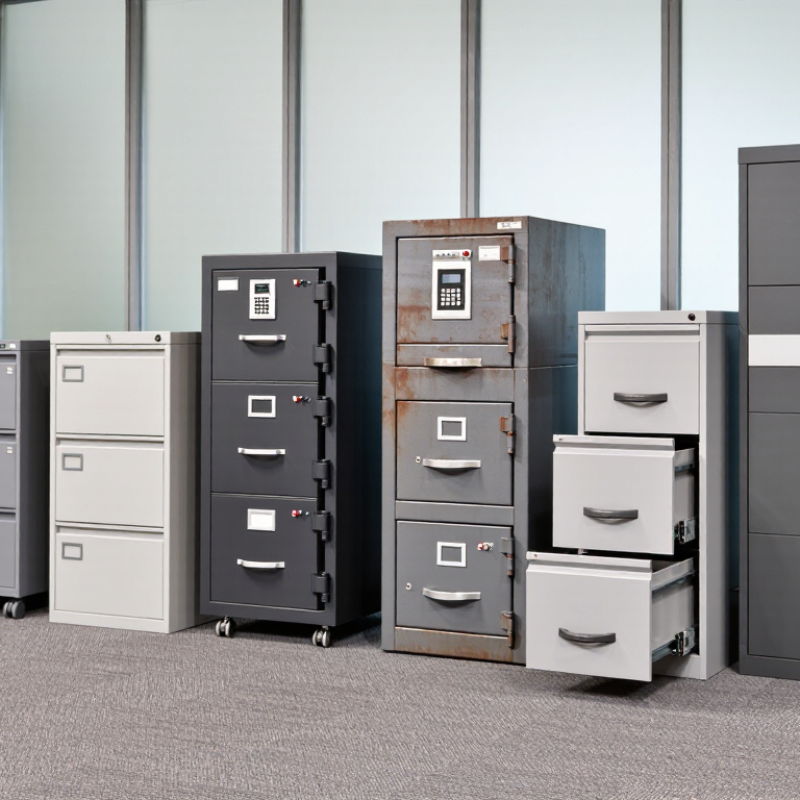
Top 10 Types of Filing Cabinets for Global Buyers

Vertical and Lateral Cabinets: A4 (210×297 mm) vs Letter (8.5×11 in)

Top 10 Types of Filing Cabinets for Global Buyers

Vertical and Lateral Cabinets: A4 (210×297 mm) vs Letter (8.5×11 in)

Choosing between vertical and lateral filing cabinets starts with document size. A4 paper measures 210×297 mm, while Letter paper measures 8.5×11 inches, or about 216×279 mm. The difference looks small. It is not always harmless.

Vertical cabinets usually store folders front-to-back. They suit narrow offices and use floor space efficiently. A4 folders often need deeper drawers because their longer side runs inward. Letter folders may fit comfortably, but check the internal drawer depth. Nominal cabinet size can mislead buyers.

Lateral cabinets store folders from side to side. Their wider drawers make labels easier to read and reduce repeated bending. They can suit shared offices, archives, and high-volume records. However, they require more wall space and may need stronger drawer supports. A4 and Letter folders can both work, but rails and hanging-folder accessories must match the chosen format.

In real purchasing projects, I have seen teams measure paper only. That was a mistake. Folder tabs, suspension rails, handles, and drawer clearance also affect capacity. Measure the usable interior, not the outside shell. Request a sample drawer specification when ordering internationally. Small dimensional errors create daily frustration. I would also question claims about holding capacity unless the supplier explains the testing method. Load ratings vary, and fully packed drawers can become difficult to open.

Mobile and Pedestal Cabinets: BIFMA X5.9 Load and Tip-Over Tests

Mobile and pedestal cabinets are often judged by appearance, but their real performance appears during movement, loading, and drawer extension. ANSI/BIFMA X5.9-2019 evaluates storage units through stability, strength, durability, and tip-over procedures. The required load depends on cabinet type and configuration, not one universal weight. That detail matters when comparing global suppliers.

In practical testing, technicians load drawers, extend them fully, and apply controlled forces to the cabinet body. Casters must remain stable while the unit moves across a hard floor. Pedestal cabinets need careful anchoring beneath desks, especially when several drawers open together. CPSC surveillance reports have estimated roughly 22,000 furniture tip-over injuries annually in the United States, using recent multi-year data. The number is not a cabinet-only figure, but it shows why stability testing deserves attention.

Buyers should request the test method, applied load, cycle count, and pass-fail records. Ask whether testing covered the delivered configuration, including casters, locks, handles, and drawer inserts. A cabinet passing an empty test can behave differently when files shift during transport. We have seen specifications that looked complete but omitted floor conditions. That omission deserves scrutiny. A useful purchasing file also records drawer extension distance, loaded weight distribution, and anti-tip interlock performance. BIFMA standards provide a professional benchmark, yet independent verification remains wise for large commercial orders.

Fire-Resistant and Media Cabinets: UL 72 and ISO 834 Fire Ratings

For global buyers, fire-resistant filing cabinets deserve closer attention than ordinary steel storage. A cabinet may look solid, yet its protection depends on tested construction, insulation, seals, and locking performance. During procurement, ask for the complete fire-test report, not only a temperature claim. Small details matter. Door gaps matter.

UL 72 evaluates record-protection equipment under controlled fire exposure. Its classifications address different contents, including paper documents and digital media. Paper records require different internal limits from magnetic tapes, disks, or other sensitive media. Buyers should confirm the exact class, test duration, and protected contents. A cabinet tested for paper should not automatically be treated as suitable for media. That assumption can become expensive.

ISO 834 defines a standard fire time-temperature curve commonly used for fire-resistance testing. It helps assess how assemblies perform during heating, but it is not automatically a complete cabinet certification. Check whether the report covers the full product, its doors, drawers, seals, and internal temperature. Installation also affects performance. Uneven floors, damaged seals, or poor anchoring may reduce protection. In practice, staff should inspect hinges and gaskets regularly, especially in humid storage rooms. I have found that maintenance is often overlooked. The rating looks impressive, but daily handling can expose its weak points. Safety labels should remain readable after years of use. Test evidence should be current, traceable, and matched to the cabinet model.

Map and Plan Cabinets: A1 (594×841 mm) and A0 (841×1189 mm)

Top 10 Types of Filing Cabinets for Global Buyers: Map and Plan Cabinets

Map and plan cabinets protect large technical drawings from folds, dust, and careless stacking. A1 sheets measure 594 × 841 mm, while A0 sheets measure 841 × 1189 mm. Choose drawers with slightly larger internal dimensions. Tight clearance damages corners during daily filing. I have seen teams measure paper only, then discover that protective sleeves need extra space.

A1 Cabinets A1 cabinets suit smaller studios, survey offices, and project rooms with limited floor area.

A0 Cabinets A0 cabinets require deeper drawers and stronger runners because each sheet covers more surface.

Check the stated load rating, drawer extension, and anti-tip design before purchase. Smooth, full-extension runners help users inspect drawings without pulling them across metal edges. It sounds minor. It prevents repeated handling damage.

Global buyers should also examine humidity control, powder-coated surfaces, lock options, and replacement parts. Coastal storage rooms may need better corrosion resistance than dry offices. Verify dimensions in millimetres, not approximate product labels. Packaging matters too; a bent cabinet frame can make accurate filing impossible. I would leave a small margin around every drawer, although that reduces capacity. That choice may feel inefficient, but crowded drawers often create higher long-term costs. Consult local workplace requirements for weight, fire safety, and secure storage before ordering.

Tambour and Open-Shelf Cabinets: EN 14073 Stability and Access Criteria

For global buyers comparing the top 10 types of filing cabinets, tambour and open-shelf cabinets deserve close attention. Their access patterns differ, but both require careful stability assessment under EN 14073 principles.

Tambour cabinets use sliding doors that retract into the sides. This saves aisle space in busy offices. Test the door movement with a full load, not an empty cabinet. Uneven floors can affect alignment. The cabinet should resist tipping during normal opening and closing. Check whether shelves remain secure when users pull files forward. Small details matter.

Open-shelf cabinets provide immediate visibility and faster document retrieval. However, exposed files can shift during movement or impact. Adjustable shelves should lock firmly and support the stated load. Heavy materials belong on lower levels. Anchor points may be necessary, especially for tall units. Do not treat a wide base as automatic proof of safety.

As a purchasing practice, request test documentation, load ratings, assembly instructions, and maintenance guidance. A supplier’s statement helps, but it is not complete evidence. Inspect door clearance, shelf deflection, sharp edges, and floor contact points. In real installations, rushed assembly often creates avoidable weakness. EN 14073 alignment should be verified against the exact cabinet configuration, including accessories and locking hardware. Different regions may also require additional workplace or building checks.

Top 10 Types of Filing Cabinets for Global Buyers — Tambour and Open-Shelf Cabinets: EN 14073 Stability and Access Criteria

Comparative specification guide for commercial office storage. Dimensions, capacities and configuration details are typical procurement ranges; final performance should be verified through the supplier’s technical documentation and applicable test reports.

No. Cabinet Type Typical Dimensions
(W × D × H, mm)
Common Filing Format Typical Storage Capacity Access Configuration Typical Shelf / Drawer Load Stability and Anti-Tip Features EN 14073 Verification Focus Best-Fit Application
1 Vertical Two-Drawer Filing Cabinet 460 × 620 × 710 A4 or Letter Approximately 180–240 linear filing cm Two front-opening drawers with full-extension runners Approximately 35–45 kg per drawer Interlocking drawers, anti-tilt mechanism, adjustable levelling feet Stability with loaded drawers; strength and durability of drawers, runners and stops; safe operation of movable parts Personal workstations and small offices
2 Vertical Four-Drawer Filing Cabinet 460 × 620 × 1320 A4, Foolscap or Letter Approximately 360–480 linear filing cm Four stacked drawers, commonly with central locking Approximately 35–45 kg per drawer One-drawer-at-a-time interlock, counterweight or anchoring provision, anti-rebound stops Resistance to forward tipping when drawers are extended; drawer retention, runner strength and operating-force checks High-density records storage in limited floor area
3 Lateral Filing Cabinet 900 × 460 × 1000 A4, Foolscap or Letter Approximately 250–400 linear filing cm Wide pull-out drawers or lateral filing bays Approximately 45–70 kg per drawer Drawer interlock, full-extension runners, levelling feet and optional wall anchoring Side-to-side and front-to-back stability; strength of wide drawers, suspension components and opening stops Shared departmental filing and accessible records
4 Mobile Pedestal Cabinet 400 × 560 × 600 A4 or Letter Approximately 100–160 linear filing cm Two or three drawers on lockable casters Approximately 20–35 kg per drawer Lockable casters, drawer interlock, anti-tip device and low centre of gravity Stability while loaded and unlocked; caster performance; drawer retention and safe movement of movable components Under-desk storage and flexible office layouts
5 Tambour-Door Filing Cabinet 800 × 450 × 1000 A4, Foolscap or Letter Approximately 600–800 mm of shelf width per level Sliding tambour door with adjustable internal shelves Approximately 35–60 kg per shelf Wide, stable base; door travel stops; levelling feet; optional floor or wall fixing Overall stability with doors and shelves loaded; strength of shelves, door tracks, stops and handles; smooth and safe access Open-plan offices and compact circulation areas
6 Open-Shelf Filing Cabinet 900 × 400 × 1200 A4 or Letter binders and folders Approximately 4–5 adjustable shelf levels Direct front access without doors or drawers Approximately 40–70 kg per shelf Back or side panels for rigidity, adjustable levelling feet and recommended anchoring for tall units Resistance to overturning and racking; shelf-support strength; retention of adjustable shelves and safe loading access Frequently used files and visible document organization
7 Plan- and Map-Drawer Cabinet 1050 × 750 × 1000 A1, A2, A3 drawings and maps Approximately 8–12 shallow drawers Wide horizontal drawers with recessed pulls Approximately 30–50 kg per drawer Drawer interlock, reinforced plinth, anti-tip restraint and full-extension runners Forward stability with extended drawers; resistance of wide drawer fronts, runners and stops to repeated use Architecture, engineering and archive departments
8 Rotary Filing Cabinet 700 × 700 × 1250 A4 or Letter folders Approximately 300–500 linear filing cm Rotating internal carousels or shelves accessed from one or more sides Approximately 25–45 kg per rotating level Wide anti-tip base, rotation stop, guarded moving mechanism and levelling feet Stability during rotation and loading; strength of rotating parts, stops and access components; prevention of unintended movement High-density storage where floor space is restricted
9 Lockable Archive Cupboard 900 × 450 × 1800 A4, Foolscap or Letter folders and boxes Approximately 5–6 adjustable shelf levels Hinged doors with lock and adjustable shelves Approximately 50–80 kg per shelf Three-point or multi-point locking, reinforced back, levelling feet and wall-anchoring provision Tall-unit stability, door and hinge strength, shelf retention and resistance to racking during normal access Central archives and controlled-access records
10 Shelving-and-Drawer Combination Cabinet 900 × 450 × 1200 A4 or Letter folders, binders and supplies Approximately 2 drawers plus 3 adjustable shelves Mixed access: front drawers and open or enclosed shelving Approximately 30–50 kg per drawer; 40–60 kg per shelf Drawer interlock, reinforced carcass, adjustable feet and anchoring provision for uneven loading Combined stability under uneven loads; strength of drawers, shelves, supports and access hardware Multi-purpose team storage and project rooms
Procurement note: EN 14073 is a European standard series for office storage furniture. Part 2 addresses safety requirements, while Part 3 covers methods for determining stability and strength; movable components may also require operational testing under the applicable standard provisions. Load ratings vary with construction, shelf span, drawer extension and installation conditions. Buyers should request dimensional drawings, loading instructions, anti-tip details, anchoring guidance and current test documentation before placing an order.

FAQS

How do A4 and Letter paper sizes affect cabinet selection?

A4 measures 210×297 mm. Letter measures 8.5×11 inches. The difference affects drawer depth and folder clearance.

When is a vertical filing cabinet suitable?

Vertical cabinets fit narrow offices. Folders usually run front-to-back. Check usable drawer depth, especially for A4 folders.

When should buyers choose a lateral filing cabinet?

Lateral cabinets store folders side-to-side. Wide drawers improve label visibility and reduce repeated bending. They need more wall space.

What should buyers measure before ordering internationally?

Measure the usable interior, not the outer shell. Include folder tabs, rails, handles, and drawer clearance. Request a sample drawer specification.

Can one cabinet support both A4 and Letter folders?

Sometimes, but compatibility is not automatic. Check rails, hanging-folder accessories, and internal dimensions for each paper format.

What should buyers test on a tambour cabinet?

Test sliding doors with a full load. Check alignment on uneven floors. The doors should move smoothly without disturbing nearby shelves.

Are open-shelf cabinets safe for heavy files?

Heavy files belong on lower shelves. Adjustable shelves should lock firmly and support the stated load. Tall units may need anchor points.

How can buyers assess cabinet stability and capacity?

Request test documents, load ratings, assembly instructions, and maintenance guidance. Inspect sharp edges, shelf deflection, and floor contact points.

Should buyers fully trust stated load ratings?

Not completely. Testing methods vary. I once trusted a capacity claim too quickly, and the packed drawer became difficult to open.

Conclusion

This guide to the Top 10 Types of Filing Cabinets helps global buyers select storage solutions based on document format, mobility, security, and workplace requirements. It compares vertical and lateral cabinets designed for A4 (210 × 297 mm) and Letter (8.5 × 11 in) documents, as well as mobile and pedestal cabinets evaluated for load capacity, stability, and tip-over resistance under BIFMA X5.9 testing principles.

It also introduces fire-resistant and media cabinets, explaining how UL 72 and ISO 834 classifications can indicate protection performance during fire exposure. For oversized drawings, map and plan cabinets accommodate A1 (594 × 841 mm) and A0 (841 × 1189 mm) sheets. Finally, tambour and open-shelf cabinets are reviewed through practical considerations such as accessibility, organization, and stability in line with EN 14073 criteria. Together, these Filing Cabinets categories provide a clear framework for making safe, efficient, and application-focused purchasing decisions.


Isabella

Isabella

Isabella is a dedicated marketing professional with a sharp focus on driving brand growth and engagement through strategic content creation. With an extensive background in digital marketing, she combines her passion for storytelling with her keen understanding of industry trends to deliver......